LLMs and voice
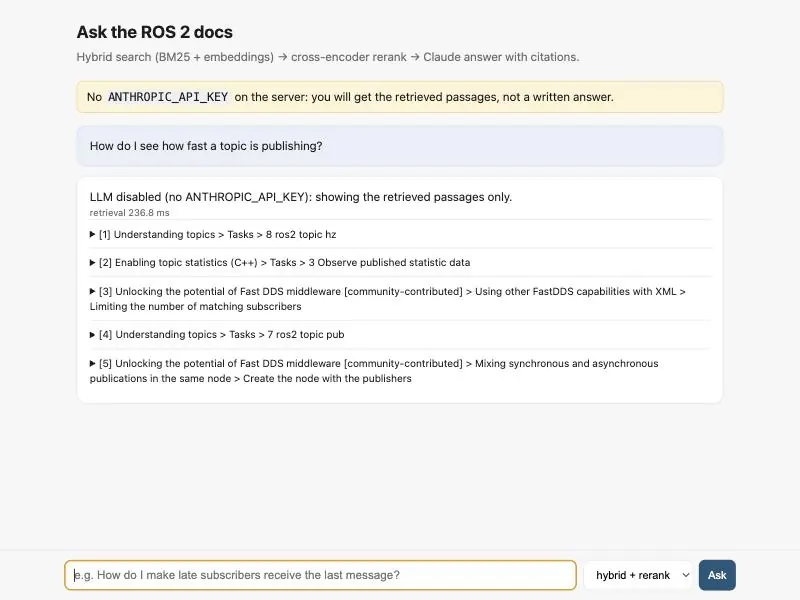
Ask the ROS 2 docs
RAG over the ROS 2 documentation: three chunkers, hybrid search, reranking and answers with citations, scored on a hand-built question set.
The problem
Most of a RAG system's answer quality is decided at retrieval, yet chunking and search choices are often made by feel. I built question answering over the ROS 2 documentation and three ROS 2 papers, and scored each retrieval choice on a question set I wrote by hand.
What I built
- Ingested 296 ROS 2 doc pages with my own reStructuredText parser that keeps heading paths and code blocks, plus three arXiv papers page by page.
- Compared three chunkers (fixed windows, recursive, section-aware with a heading prefix) against four retrieval modes: BM25, dense, reciprocal-rank fusion, and fusion plus cross-encoder reranking.
- Wrote 61 answerable and 5 unanswerable questions. A chunk counts as relevant if it comes from a gold document and contains an answer phrase, so every chunker is scored on equal terms.
- Claude answers from the top five passages and cites every sentence or abstains, behind a FastAPI backend, a chat UI, a CLI and a Dockerfile.
Results
| Chunking | Retrieval | Hit@1 | Hit@5 | MRR@10 | ms/query |
|---|---|---|---|---|---|
| fixed (180 words) | BM25 | 0.279 | 0.705 | 0.454 | 1 |
| fixed | hybrid + rerank | 0.426 | 0.803 | 0.579 | 176 |
| section + heading prefix | dense | 0.459 | 0.738 | 0.596 | 6 |
| section + heading prefix | hybrid (RRF) | 0.426 | 0.787 | 0.574 | 8 |
| section + heading prefix | hybrid + rerank | 0.590 | 0.803 | 0.690 | 159 |
What the results show
- The reranker is what puts the right passage first. On section chunks it lifts Hit@1 from 0.426 to 0.590 while Hit@5 barely moves, so it reorders candidates that were already in the list.
- Section chunking beats fixed windows by 0.111 MRR only with the reranker (p = 0.007). Without it no chunker difference is significant.
- The embedding model matters for dense-only search, where BGE-small beats MiniLM by 0.18 MRR, but the gap vanishes under the reranker.
- Even the best setup misses 7 of 61 questions in the top 10. The misses are mostly an answer split across neighbouring chunks, a vocabulary gap, or a flattened PDF table.
Limitations
- 61 questions give intervals of about ±0.10 on MRR, so only large differences are detectable, and p-values aren't corrected for multiple comparisons.
- I wrote the questions after reading the docs, so they favour facts stated clearly in one place.
- Answer quality needs an Anthropic API key. The judge is implemented but has not been run, so there is no faithfulness or citation-accuracy number.
Full results, commands and figures are in the repository README.