Computer vision
Lane detection, classical vs deep
The same problem solved twice, with a hand-built OpenCV pipeline and a U-Net, and scored head to head on the full TuSimple test set.
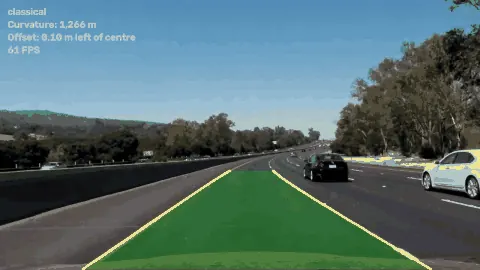
The problem
Lane keeping needs to know where the two lines around the car are, and a hand-tuned OpenCV pipeline can often find them. Deep networks are the default now, but the comparison is rarely made on equal terms. I built both, gave them the same output format and scored them once on the same test set to see where each one wins and fails.
What I built
- Classical pipeline: chessboard calibration, a bird's-eye homography, colour and gradient thresholds, sliding windows and a polynomial fit per lane. Its parameters are grid-searched on 1,000 training images.
- A U-Net with a pretrained ResNet-34 encoder that labels each pixel with its lane slot, trained with weighted cross-entropy plus Dice because lane pixels are about 2 % of the image. The checkpoint is picked on validation accuracy.
- Both detectors feed the same TuSimple metric, curvature and offset measurement and lane-departure warning, and are scored once on the full test set.
- Exported the network to ONNX (FP32, FP16, INT8) and CoreML, re-scored every variant, and ported the post-processing to JavaScript so the INT8 model runs in the browser.
Results
| Method | Ego acc | Ego FP | Ego FN | All-lanes acc | ms / frame |
|---|---|---|---|---|---|
| Classical, tuned on train | 0.773 | 0.330 | 0.395 | 0.541 | 9.8 |
| U-Net ResNet-34 | 0.951 | 0.053 | 0.051 | 0.950 | 20.7 |
What the results show
- On its home domain the network cuts false positives and negatives from 33–40 % to about 5 %. Most classical failures are faint dashes and Botts' dots that fixed thresholds can't see.
- The classical pipeline is twice as fast, needs no training data, and every failure can be traced in its debug views.
- More data helped the network more than more epochs: a model trained on a 233-image subset for 60 epochs reached 0.914 ego accuracy on that subset's own test split.
- INT8 costs 0.001 ego accuracy at a quarter of the size. CoreML FP16 moves lane points by a median 8 px, still inside TuSimple's 20 px tolerance.
Limitations
- Neither method holds up off-domain. On Udacity's challenge video the classical pipeline follows an asphalt seam, and the network gives unstable curves and a false departure warning.
- The departure warning uses a homography calibrated on straight road, so tight bends can trigger false warnings.
- Daytime highway data only, and no temporal smoothing of the network output in video.
Full results, commands and figures are in the repository README.