Robotics
Robot arm imitation learning
A simulated MuJoCo arm learns pick-and-place from demonstrations. Controlled runs compare behaviour cloning with my own ACT to find which part does the work.
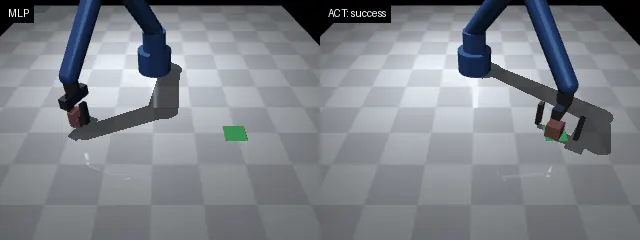
The problem
Imitation learning teaches a robot from demonstrations instead of a reward. Action Chunking with Transformers (ACT) is a popular recipe, but it bundles several ideas at once: a transformer, a CVAE latent, predicting chunks of future actions and averaging overlapping chunks. I wanted to know which of those parts actually makes it work.
What I built
- Built my own MuJoCo task: a 5-joint arm with a two-finger gripper picks a cube at a random pose and places it on a random goal, controlled at 20 Hz.
- Wrote a scripted expert with damped-least-squares IK. It produces 600 demonstrations, and the policies only see observation-action pairs.
- Trained a plain MLP and my own state-based ACT on the same data, and scored every run on 300 unseen layouts.
- Ran controls that change one thing at a time: memory, model size, chunk length, ensembling, checkpoint choice, data size and execution noise.
Results
| Policy | Parameters | Mean success |
|---|---|---|
| MLP, next action only | 137k | 0.1 % |
| MLP, chunk 20 + ensembling | 166k | 87.3 % |
| ACT, chunk 20 + ensembling | 1.3M | 99.0 % |
| ACT, newest chunk only | 1.3M | 31.2 % |
| ACT, final epoch | 1.3M | 8.9 % |
What the results show
- The plain MLP has the lowest validation error of all policies and solves almost nothing. After the gripper closes, the expert waits 8 steps while the state barely changes, and a policy without memory stalls there.
- Most of the gain comes from predicting chunks and averaging them. A 166k-parameter MLP with chunking and ensembling gets close to ACT.
- Ensembling matters most: the same ACT models using only the newest chunk drop to 1–84 % depending on the seed.
- ACT's CVAE latent is unused (KL 0.000), which fits a deterministic expert.
Limitations
- ACT's 99 % depends on the checkpoint. Validation error is lowest near epoch 13 of 50, and the final-epoch weights reach the goal only 8.9 % of the time.
- Policies see the true cube pose, so this says little about vision or real robots.
- The idea that older chunks act as memory during the wait is an inference I haven't tested directly.
Full results, commands and figures are in the repository README.