Computer vision
Face recognition and anti-spoofing
Verification and open-set identification on LFW, plus a presentation-attack detector and a head-turn liveness challenge.
The problem
Face verification on LFW is close to saturated, so a high accuracy there says little. The more useful questions sit around it: what face alignment is worth, what changes when one comparison becomes a search over a whole gallery, and whether an anti-spoofing model's validation score holds on unseen people.
What I built
- Detection with OpenCV YuNet, my own Umeyama alignment to the ArcFace 5-point template, and ArcFace (512-d) or SFace (128-d) embeddings. The gallery stores embeddings only.
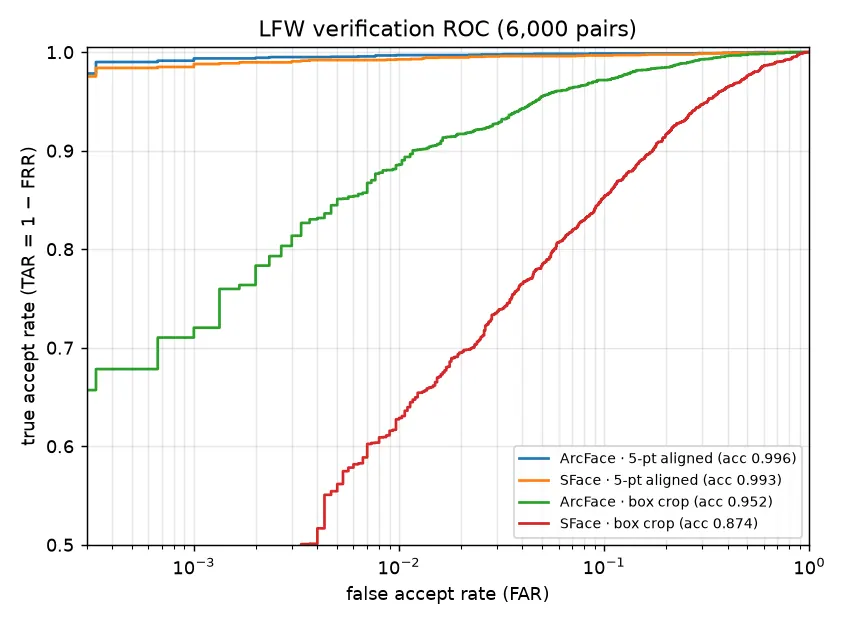
- Scored verification with the LFW 10-fold protocol on 6,000 pairs, with aligned crops and with plain detector boxes.
- Ran open-set identification with one photo each of 1,680 people enrolled, 7,484 probes of those people and 4,069 photos of strangers.
- Trained a ResNet-18 presentation-attack detector on a CelebA-Spoof subset with the threshold fixed on validation, and added a randomised head-turn liveness challenge.
Results
| Embedder | Crop | Accuracy | EER | TAR @ FAR 10⁻³ |
|---|---|---|---|---|
| ArcFace (512-d) | 5-point aligned | 99.55 % ± 0.34 | 0.47 % | 99.37 % |
| SFace (128-d) | 5-point aligned | 99.32 % ± 0.40 | 0.80 % | 98.80 % |
| ArcFace | detector box | 95.23 % ± 0.79 | 4.83 % | 72.03 % |
| SFace | detector box | 87.37 % ± 1.30 | 12.60 % | 42.07 % |
What the results show
- Alignment is worth 4.3 points for ArcFace and 12 for SFace. At FAR 10⁻³ the un-aligned crops reject 28 % and 58 % of genuine users.
- A 1:1 threshold doesn't carry over to 1:N. The 0.25 threshold lets 43.4 % of strangers through against 1,680 people; the app's 0.35 keeps that at 0.76 % while still matching 98.17 % of known faces.
- The spoof detector's validation EER is 1.5 to 1.7 % but test EER is 8 to 15 %. An identity check explains it: 77 % of validation faces match a training identity, against 22 % on test, so about a quarter of attacks get through.
- The tightest crop tests best, but I kept the default chosen before testing, since switching afterwards would be tuning on the test set.
Limitations
- With 3,000 impostor pairs, FAR 10⁻³ rests on 3 pairs, so those numbers are only indicative.
- The CelebA-Spoof mirror has no subject IDs or attack-type labels, so there is no per-attack breakdown and no identity-disjoint validation yet.
- LFW skews towards lighter-skinned, male public figures, and there is no demographic-bias evaluation.
Full results, commands and figures are in the repository README.